PCL-5 Clinical Guide: Administration & Scoring Best Practices
When working with trauma survivors, effective assessment balances clinical precision with deep empathy—all while upholding the highest ethical standards. For mental health practitioners, the PTSD Checklist for DSM-5 (PCL-5) is an indispensable tool for screening and monitoring symptoms. However, its effectiveness hinges on correct application. How can you ensure your use of the PCL-5 is both clinically robust and ethically sound?
This guide provides clinicians, counselors, and researchers with essential insights into the PCL-5. We will cover best practices for accurate administration, reliable scoring, and meaningful interpretation in professional settings. Mastering these fundamentals allows you to fully harness the PCL-5's insights to better understand your clients' needs and meaningfully track their progress. Discover how a standardized platform can enhance your practice and support your clients on their path to recovery.

Mastering PCL-5 Administration: Ethical Guidelines & Procedures
Proper administration is the foundation of any valid psychological assessment. The PCL-5 is no exception. Ensuring the process is handled correctly from start to finish protects the integrity of the results and respects the client's experience.
Who Can Administer the PCL-5 Effectively?
The PCL-5 is a professional tool designed for use by individuals with appropriate training in mental health assessment. This typically includes:
- Licensed Clinicians: Psychologists, psychiatrists, clinical social workers, and licensed professional counselors.
- Researchers: Academics and research assistants operating under the supervision of a qualified principal investigator.
- Healthcare Professionals: Physicians and nurses with specific training in mental health screening.
The key qualification is not just a professional title, but a solid understanding of psychometric principles, trauma-informed care, and the ethical responsibilities involved in handling sensitive client data. The administrator must be equipped to answer client questions and respond appropriately to any distress the assessment may evoke.
Pre-Assessment Setup: Informed Consent & Environment
Before the client answers the first question, two critical elements must be in place: informed consent and a proper environment.
Informed Consent: Clearly explain to the client what the PCL-5 is and what it is not. Inform them that it is a symptom checklist, not a definitive diagnostic test. Discuss confidentiality, how their results will be used, and who will have access to them. This transparent communication builds trust and empowers the client in their own assessment process.
Environment: The setting should be safe, private, and free from distractions. Whether administered in an office or via a secure online platform, the client needs to feel comfortable enough to reflect honestly on their experiences. A rushed or public setting can compromise the validity of the responses.

Practical Tips for Administering the PCL-5 in Clinical Settings
To ensure the highest quality results, consider these practical tips during administration:
- Provide Clear Instructions: Explain that the questions refer to the past month. Emphasize that there are no "right" or "wrong" answers and encourage them to respond based on how much they have been bothered by each symptom.
- Be Present and Supportive: If administering in person, maintain a supportive and non-judgmental presence. If using an online tool, ensure the client knows how to contact you if they feel distressed or have questions.
- Utilize a Standardized Format: Using a consistent format, such as the one offered by our secure platform, ensures every client receives the same instructions and questions. This standardization is crucial for reliably tracking progress over time and minimizing variables that could affect scoring.
PCL-5 Scoring and Interpretation Manual: From Raw Scores to Insights
Once the PCL-5 is completed, the focus shifts to scoring and interpretation. A raw score is just a number; its clinical value comes from a thoughtful and contextualized understanding of what it represents.
Step-by-Step PCL-5 Scoring: A Guide for Practitioners
The PCL-5 consists of 20 items that correspond to the PTSD symptom criteria in the DSM-5. Scoring is straightforward:
- Each item is rated on a 5-point Likert scale, from 0 ("Not at all") to 4 ("Extremely").
- The total PCL-5 severity score is calculated by summing the scores for all 20 items.
- The possible score range is 0 to 80.
Manual scoring does carry the risk of human error. Automated tools guarantee accuracy and efficiency. This frees up valuable clinical time to focus on your clients rather than calculations with an automated scoring tool.
What Do PCL-5 Scores Mean? Understanding Severity Thresholds and Cutoffs
A common question from practitioners is, "What is a high PCL-5 score?" While interpretations can vary based on the population, the U.S. National Center for PTSD suggests a provisional cutoff score of 31-33 may indicate that PTSD is a concern worth further investigation.
It is critical to remember that this is a provisional cutoff, not a diagnostic threshold. A score above this range does not automatically mean a client has PTSD, and a score below it does not rule it out. The score is best used as an indicator of symptom severity, which can be generally categorized as:
- 0-30: Mild to no significant symptom burden.
- 31-50: Moderate symptom burden.
- 51-80: High to severe symptom burden.
These ranges help quantify a client's distress level and provide a baseline for measuring change.
Contextualizing PCL-5 Results: Beyond the Numerical Score
A truly insightful interpretation goes beyond the total score. Clinicians should also:
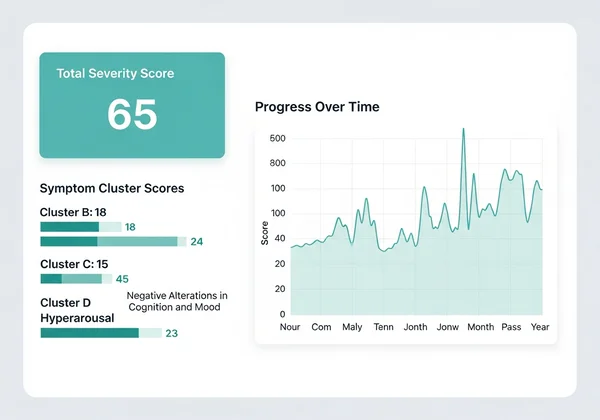
- Analyze Symptom Clusters: Review scores within the four main PTSD symptom clusters: Intrusion (items 1-5), Avoidance (items 6-7), Negative Alterations in Cognitions and Mood (items 8-14), and Alterations in Arousal and Reactivity (items 15-20). This can reveal specific areas of struggle and inform treatment planning.
- Consider the Full Clinical Picture: Integrate the PCL-5 score with information from clinical interviews, client history, and other assessment data. A single score cannot capture the complexity of a person's life and experiences.
- Discuss Results Collaboratively: Use the score as a starting point for a conversation with the client. Ask them if the results align with their experience. This collaborative approach validates their perspective and strengthens the therapeutic alliance.
Integrating the PCL-5 into Comprehensive Clinical Assessment
The PCL-5 is most powerful when used as part of a broader, multi-faceted assessment strategy. It serves as an efficient screener and an effective progress monitor that complements more in-depth diagnostic tools.
PCL-5 and CAPS-5: Complementary Roles in PTSD Diagnosis
The PCL-5 should not be confused with the Clinician-Administered PTSD Scale for DSM-5 (CAPS-5). The CAPS-5 is considered the "gold standard" for PTSD diagnosis and involves a structured clinical interview that provides detailed, nuanced information.
The two tools work best together:
- PCL-5: A self-report measure that is quick, easy to administer, and ideal for initial screening and ongoing monitoring.
- CAPS-5: A clinician-administered interview that is used for a definitive diagnosis and a deeper, more comprehensive assessment of symptoms.
A clinician might use the PCL-5 to identify individuals who may need a full CAPS-5 assessment or to track client progress between more intensive evaluations.
Utilizing the PCL-5 for Monitoring Treatment Progress
One of the most valuable applications of the PCL-5 is tracking treatment outcomes. Administering the assessment at regular intervals (e.g., at intake, monthly, and at discharge) provides objective data on symptom changes. A significant decrease in the PCL-5 score over time is a strong indicator of treatment efficacy. This data is invaluable for adjusting treatment plans, celebrating client progress, and demonstrating the effectiveness of your interventions.
Ethical Communication: Discussing PCL-5 Results with Clients
How you discuss the results is as important as the results themselves. Approach the conversation with empathy and a collaborative spirit.
- Explain that the score reflects their symptoms over the past month and can change. Frame it as a "snapshot" of their current experience.
- Avoid diagnostic labels and use person-centered language. Instead of saying "You have a high score," try saying, "The score suggests you've been experiencing significant distress recently."
- Connect symptoms to daily life. For example, "It looks like difficulty concentrating has been making work challenging."
- Use the results to collaboratively identify treatment goals and affirm your client's courage in addressing their experiences.
Empowering Your Practice with Expert PCL-5 Application
The PCL-5 is more than a questionnaire; it is a clinical instrument that, when used correctly, can profoundly enhance your ability to support individuals impacted by trauma. By adhering to best practices, you gather reliable data and use it in an ethical, client-centered way.
Benefits of Standardized Assessment Platforms
Adding a standardized digital assessment to your practice can help ensure accuracy, save valuable time, and create a smoother experience for both you and your clients. An online platform automates scoring, reduces the risk of error, and securely stores client data, allowing you to focus more on therapeutic interaction and less on administrative tasks.
Implementing PCL-5 in Your Clinical Workflow
Integrating a tool like the PCL-5 into your regular workflow provides consistent, measurable data for treatment planning and progress monitoring. This strengthens your clinical judgment and helps clients see their own progress objectively. We invite you to streamline your assessments and discover a reliable resource for your clinical needs.
Frequently Asked Questions for PCL-5 Professionals
Can the PCL-5 provide a definitive PTSD diagnosis?
No. The PCL-5 is a highly effective screening and symptom monitoring tool, but it cannot provide a standalone diagnosis. A definitive PTSD diagnosis must be made by a qualified mental health professional following a comprehensive clinical evaluation, which may include tools like the CAPS-5.
What is the recommended age range for PCL-5 administration?
The PCL-5 was developed and validated for use with adults (ages 18 and older). For assessing trauma symptoms in children and adolescents, other age-appropriate measures, such as the Child PTSD Symptom Scale (CPSS-5), should be used.
How often is it appropriate to re-administer the PCL-5 in treatment?
The frequency depends on the clinical setting and treatment goals. A common practice is to administer it at intake, then perhaps monthly or quarterly to monitor progress. The key is to establish a consistent schedule that provides meaningful data without overburdening the client.
Are there specific training requirements for PCL-5 use?
While there is no formal certification for the PCL-5, it should only be used by professionals who have training in psychometric assessment, clinical interviewing, and trauma-informed care. Understanding the nuances of trauma is essential for ethical and effective application.
How can our professional assessment platform assist in your clinical use of the PCL-5?
Our assessment platform provides a secure, user-friendly, and confidential platform for clients to complete the PCL-5. Our service offers instant and accurate scoring, multi-language support to serve diverse populations, and an optional AI-driven report that can generate deeper insights for therapeutic discussion. You can explore our platform to see how it can fit into your clinical workflow.